
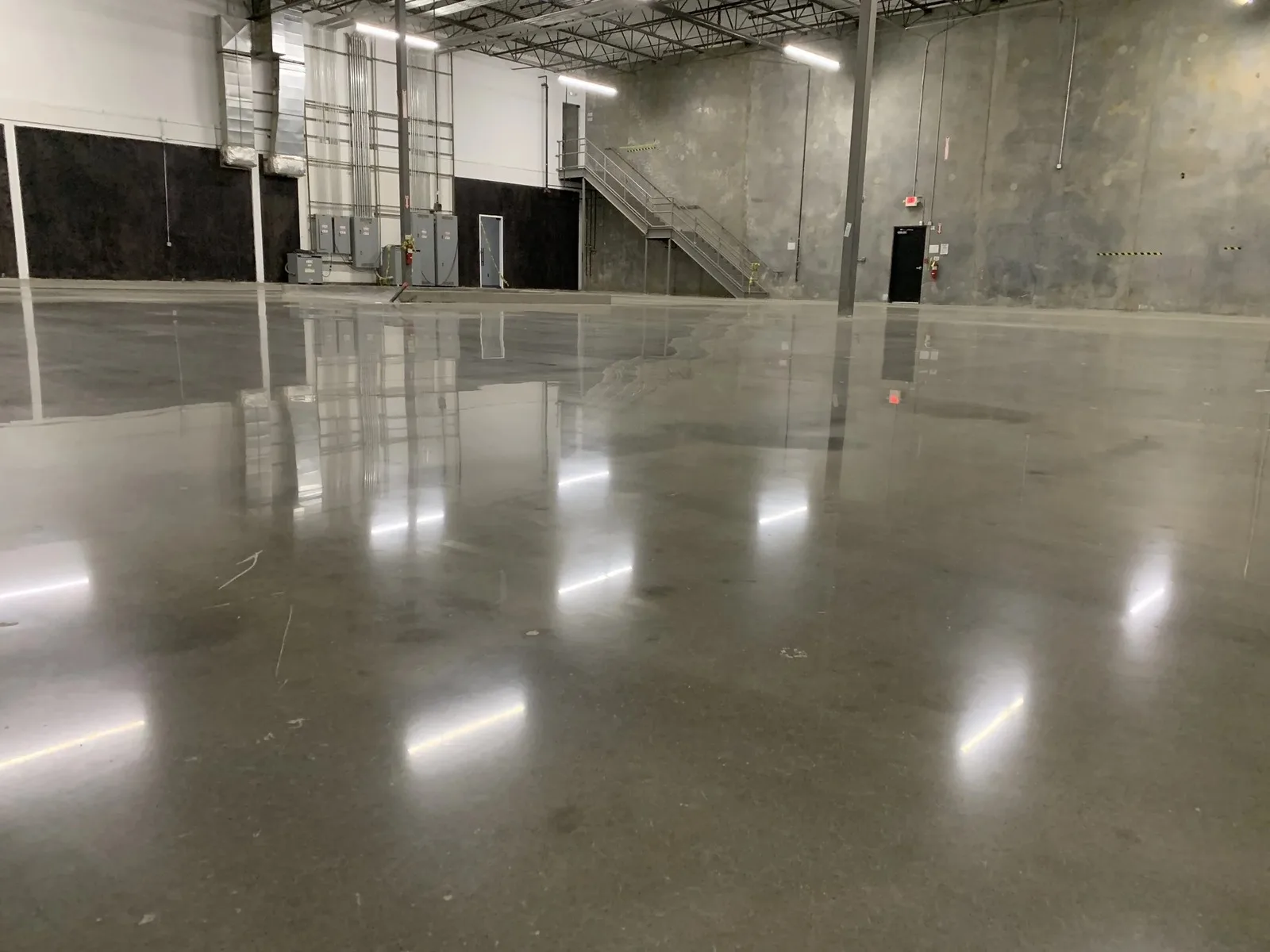
Polished concrete vs epoxy floors: which is better for a Utah garage, basement or shop?
Neither one wins everywhere. Polished concrete is the slab you already own, ground smooth and hardened, so it cannot peel. Epoxy is a coating bonded on top, so it adds color and blocks oil and road salt. Utah garages usually get a coating. Sound shop and warehouse slabs usually get polished.
We grind, polish and coat concrete along the Wasatch Front. The cost ranges below come from published national guides, and every row names where it came from. None of them are our prices. If polishing is already the direction you want, our concrete polishing service page covers the grinding sequence and the gloss levels.
What is polished concrete, and what is an epoxy floor?
Polished concrete is a mechanical finish. A heavy grinder cuts the slab flat, a densifier hardens the surface, and finer diamond passes bring up the shine. An epoxy floor is a chemical finish. Resin and hardener bond to the ground concrete and cure into a plastic layer with color in it.
That difference drives most of what follows. A polished floor has nothing sitting on the surface, so there is no film to peel, blister or lift. What you see is stone and cement, cut open by the grinder. You pick how deep we cut. A cream finish shows almost no stone. Salt and pepper shows speckles. A deeper cut shows full aggregate.
An epoxy floor is a new surface over the old one. It hides a slab that has taken a beating, which polishing cannot do. It comes in a solid color, a flake blend or a metallic pour. A clear polyaspartic or urethane top coat goes over it. Oil, brake fluid and salt water sit on that film instead of soaking into the concrete.
| Polished concrete | Epoxy coating | |
|---|---|---|
| The look | The slab itself, matte through high gloss; cream, salt and pepper or full stone | Solid color, flake blend or metallic, under a clear top coat |
| How it is made | Progressive diamond grinding plus a densifier that hardens the slab | Grind, repair, epoxy base, flake or metallic, clear top coat |
| Hot tires | No film on top, so hot tire pickup is not a failure mode | A ground in system with a clear top coat holds; thin store kits lift |
| Road salt and de-icer | Salt water dries on open concrete and can stain; a guard coat and mopping keep it in check | The film keeps brine out of the slab and mops off |
| Moisture from below | Vapor passes through the floor, so there is nothing to push off | Needs a moisture test on a damp or below grade slab |
| Slip | Fine when dry; high gloss plus water is the risk | Flake broadcast gives grip; smooth gloss is slick wet |
| Maintenance | Dust mop, neutral cleaner, re-burnish every 12 to 24 months | Sweep and mop; the clear top coat takes the wear |
| Repairs | Worn lanes re-burnish; patches take polish differently and stay visible | Chips and scratches get sanded and recoated in place |
| Lifespan | Can last a lifetime with regular mopping (Concrete Network) | Cost guides put epoxy at 5 to 10 years, polyaspartic top coat systems at 15 to 25 |
| Installed cost | $3 to $12 per sq ft (Concrete Network) | $4 to $10 per sq ft (HomeGuide) |
How is each floor installed?
Both start the same way, with diamond tooling and repair work. Polishing then steps through finer grits, with a densifier soaked in along the way, and stops at the gloss you picked. A coating stops at the coarse grind, then builds up in layers: an epoxy base, flake or metallic, and a clear top coat.
Polishing works with one material, the concrete. The first passes with coarse tooling flatten the floor and open the pores. The densifier is a liquid hardener that reacts inside the slab and makes the surface tougher. Then the finer grits refine it until the floor reflects light. A guard coat goes on last to slow stains. Color is optional, from a dye or an acid stain worked in before the final passes.
A coating job is layers. We grind to open the concrete, fix cracks and spalled areas, then roll the base coat. Flake goes into the wet base in your color, and the loose flake gets scraped back before the clear top coat. Most garages are finished in a day, and a trailer holds what came out of the garage while we work.
Which one holds up in a Utah garage?
For most Utah garages, the coating. Road salt and de-icer ride in on the tires all winter, and a coated floor keeps that brine out of the concrete. Hot tires are the other test. A ground slab with an epoxy base and a clear top coat handles them. Thin store kits do not.
Polished concrete does work in a garage, and some people like the look of it. The catch is what melts off the car. Salt water dries on open concrete and leaves white marks, and it soaks in where the surface is porous. A guard coat and regular mopping keep that in check, so it is more upkeep than a coated floor.
Hot tire pickup is worth being clear about. Tires get hot, grip a soft film as they cool, and pull it off the slab when the car backs out. A polished floor has no film to pull. What fails in a garage is a thin water based kit over an acid etch. Our garage floor coatings are ground in and top coated, and failed kits get ground off before anything new goes down.
Outside the door, the freeze thaw cycle chips and spalls the apron every winter. That matters for polishing, because grinding cuts damage wider before it cuts it away. If a coating is already the direction, the next choice is the top coat, and epoxy versus polyaspartic covers that one.
Which one works in a basement or on a slab with moisture?
Moisture decides this one. A below grade slab pushes water vapor up through the concrete. Polished concrete lets that vapor pass, so there is nothing sitting on top for it to push off. A coating traps it, which is why we moisture test a basement slab before anyone picks a system.
The test is a small job that prevents a big one. If the slab reads dry, a coating goes down the way it would in a garage. If it reads wet, the build changes, starting with a base coat that tolerates vapor. Skipping that step is how basement floors bubble and let go a year later.
A finished basement usually calls for color, and that points to a coating. We install metallic and flake epoxy floors in Utah basements, and you pick the color and the pattern. Polished concrete is the simpler floor when the slab is sound and dry and gray stone suits the room. Cold storage rooms under the front porch can go either way, since they hold shelves and boxes. Our basement floor coatings page covers the moisture side in more detail.
Which one fits a shop or a commercial floor?
Depends on what rolls across it and what spills on it. Polished concrete takes forklift traffic and dropped tools without chipping, and the shine bounces overhead light back into the room. Epoxy wins where chemicals, oil or wash water hit the floor, and where you need a set color or marked out lanes.
Warehouses are the clearest case for polishing. The slab is already there, it is usually hard and flat, and there is no film for a pallet jack to gouge. Light reflectance is a real benefit in a tall building. A polished floor sends fixture light back down the aisles instead of soaking it up.
Shops, food areas and wash bays go the other way. A film blocks what bare concrete would absorb, and flake gives wet feet something to grip. Thicker builds go into warehouses, hangars and production floors through our commercial epoxy floors page. The slab and the work happening on it decide the answer, so we look at both before quoting.
What does polished concrete cost, and what does epoxy cost?
They overlap. Concrete Network puts polished concrete at $3 to $12 per square foot installed. The low end is a basic grind. The high end is color and detail work. HomeGuide puts epoxy flooring at $4 to $10 per square foot installed. Prep and slab condition move both numbers.
| Floor and finish | Published range per square foot | Source |
|---|---|---|
| Polished concrete, basic: one stain layer, moderate shine, light prep | $3 to $5 | Concrete Network |
| Polished concrete, mid range: two stain colors, glossier finish, heavy prep | $5 to $8 | Concrete Network |
| Polished concrete, high end: multiple colors, hand applied detail | $8 to $12 and up | Concrete Network |
| Polished concrete, full published span | $3 to $12 basic, $5 to $15 and up for decorative | HomeGuide |
| Epoxy flooring, installed | $4 to $10 | HomeGuide |
| Polyaspartic top coat system, installed | $5 to $12 | HomeGuide |
| Repairing a rough slab before polishing | adds about $2 | Concrete Network |
| Polishing a floor above grade | adds $2 to $3 | Concrete Network |
None of those are our prices. They are national ranges published by cost guides. Concrete Network is direct about what drives the polishing number. The glossier the finish, the more grinding steps it takes, and more steps cost more. It also prices two add ons that surprise people. One is repair work on a rough slab. The other is polishing a floor above grade.
A real number for your floor needs an on-site look. Square footage, slab condition, gloss level, color and edge work all move the price, and none of that shows over the phone. Published garage numbers by size and system are in what an epoxy garage floor costs in Utah.
What does each floor take to maintain?
Polished concrete asks for a dust mop and a neutral cleaner. A re-burnish every 12 to 24 months brings the gloss back. A coated floor asks for sweeping and mopping, and the clear top coat takes the wear. Grit is what dulls both of them, so the mop matters more than the cleaner.
Repairs are where they split. A chip or scratch in a coating gets sanded and recoated in place. The patch blends, because the same material goes back on. Worn traffic lanes on a polished floor get re-burnished and come back to gloss. A patch in a polished slab is the exception. Filler takes color and polish differently than the original mix, so a repaired area stays visible.
The end of life looks different too. A coating that finally gives up comes off with a grinder, and a new system goes down on the same slab. A polished floor that has gone dull gets ground and polished again, with no new material to buy.
Which floor should you pick, room by room?
Pick the coating when the slab is damaged, when you want a color, or when oil and chemicals hit the floor. Pick polishing when the slab is hard, flat and sound, and you like the look of stone. Garages lean one way, warehouses lean the other, and basements go either way.
| Room | What usually fits | Why |
|---|---|---|
| Attached garage | Flake epoxy under a clear top coat | Road salt, hot tires, and a floor that wipes clean |
| Finished basement | Metallic or flake coating, after a moisture test | Color and pattern matter in a living space |
| Cold storage room | Solid color coating or a polish | Shelves and boxes, low upkeep |
| Home shop | Either one; polished if the slab is sound | Dropped tools chip a film, not a ground slab |
| Warehouse | Polished concrete | Forklifts, light reflectance, no film to strip |
| Wash bay or chemical area | Epoxy with flake broadcast in | Chemical resistance and grip underfoot |
Complete Concrete Coatings has worked on Utah concrete since 2005, out of a shop in Centerville. The slab decides more than the brochure does. We come out, look at the concrete, and check moisture on a below grade floor. Then we say which of the two fits the room. Estimates are free, and you get a written number for that floor before the crew leaves. Call (801) 347-4518 Monday through Friday, 8am to 5pm, or send the form on our contact page.