
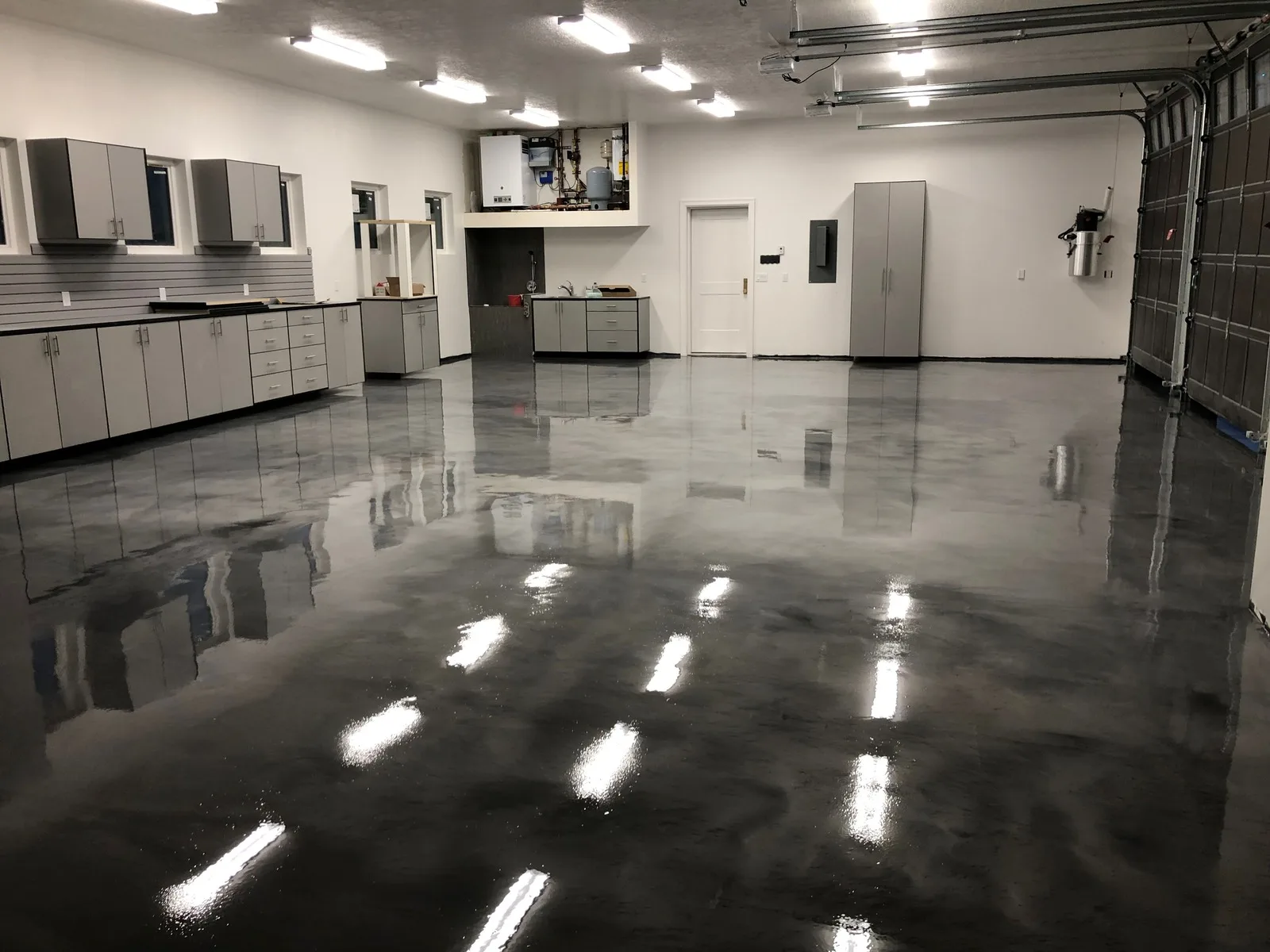
Epoxy vs polyaspartic garage floor coatings: which is better for a Utah garage?
Epoxy bonds deeper into concrete, tolerates a damper slab, and costs a dollar or two less per square foot. Polyaspartic cures in hours instead of days, holds its color in sun, and can be applied down to 35 degrees. Most Utah garages get both: an epoxy base with a polyaspartic top coat. The choice is really about which layer does which job.
We install both in garage floor coatings across the Wasatch Front, so this is not a sales page for one chemistry. The numbers below come from manufacturer data sheets and published cost guides, with the marketing claims flagged where they do not hold up.
What is the difference between epoxy and polyaspartic?
Epoxy is a two part product: a resin and a polyamine hardener that react into a hard plastic. It has been the garage floor standard for decades because it wets into ground concrete well and builds thick.
Polyaspartic is a type of polyurea. Straight polyurea reacts almost instantly and is made with an aromatic isocyanate, which yellows in sunlight. Polyaspartic uses an aliphatic isocyanate and a hindered amine, which slows the reaction to a workable window and, because aliphatic molecules do not absorb UV the way aromatic ones do, keeps the film clear. Sherwin-Williams files it in the urethane family. Chemistry aside, the practical differences are in the table.
| Epoxy | Polyaspartic | |
|---|---|---|
| Cure at room temperature | Touch in 6 to 8 hours; 2 to 3 days before chemicals (Sherwin-Williams GP3579) | Touch in 1 hour, foot traffic 6 hours, wheeled traffic 24 hours (Sherwin-Williams GP4850) |
| Sun exposure | Ambers and yellows over time | UV stable; Simiron reports 87 to 89 percent gloss retention after 1,000 hours of QUV testing |
| Minimum application temperature | 50 degrees F, air and slab | 35 degrees F, air, slab and material |
| Flexibility | Rigid; Sherwin-Williams markets its epoxy primer as low modulus and stress relieving | 5 to 10 percent elongation; passes a 1/8 inch mandrel bend |
| Chemical resistance | Good once fully cured | Excellent on motor oil, gasoline, brake fluid, antifreeze and 20 percent sodium chloride (Simiron) |
| Working time | 25 to 30 minute pot life | 15 minute working time, 20 to 25 minute pot life |
| Installed cost | $4 to $10 per sq ft (HomeGuide) | $5 to $12 per sq ft (HomeGuide) |
| Service life | 5 to 10 years in most cost guides | 15 to 25 years; Penntek backs its system with a 15 year residential warranty |
How fast can I park on it?
This is where the two split hardest. Sherwin-Williams’ GP4850 polyaspartic takes foot traffic at 6 hours and wheeled traffic at 24 hours at 77 degrees. Its GP3579 epoxy primer is dry to the touch in 6 to 8 hours and wants 2 to 3 days before water or chemicals touch it. Consumer guides stretch that to a week for vehicles on a full epoxy system, and Rust-Oleum’s DIY kit says 3 days before you park.
For a working garage that matters. A polyaspartic top coat gets the cars back in the next day. That is the main reason installers put it on top even when the base coat is epoxy.
Which one handles road salt and hot tires?
Road salt is the Utah question. UDOT pre-treats with brine and spreads rock salt plus high performance salts through the winter, and all of it rides home in the wheel wells. Simiron’s polyaspartic data sheet rates 20 percent sodium chloride as excellent, tested after a full cure. That is the cleanest published salt number we have found for any garage coating. One caution: the tests use sodium chloride, and Utah also uses magnesium chloride, so the results are close but not identical.
Hot tire pickup is more even than the marketing suggests. Tires reach 140 degrees or more on a summer afternoon, and a soft coating grips the rubber as it cools. Polyaspartic tops cure harder and hold up better, but Sherwin-Williams’ own polyaspartic sheet says the coating is resistant, not a guarantee against tire staining, and recommends mats under the tires. The store kits that peel in the first summer are thin water based epoxy over an acid etch. A ground slab with a 100 percent solids base and a polyaspartic top is a different floor.
Can either one go down in a Utah winter?
Epoxy cannot, at least not without heat. Sherwin-Williams’ epoxy primer lists a 50 degree minimum for air and slab, and Rust-Oleum’s kit wants 60 to 85. Salt Lake City’s average January high is about 38 degrees, so an unheated garage sits out of spec for most of the winter.
Polyaspartic is rated to 35 degrees by Sherwin-Williams and Simiron, and Simiron requires its fast cure version below 60. That is a real advantage from November to March. It is not the minus 30 that some contractor sites claim. We could not find a manufacturer data sheet that supports application below 30 degrees, so treat the subzero numbers as marketing. The full winter picture, including why the slab is colder than the air, is in coating a garage floor in winter in Utah.
What does each one cost?
HomeGuide prices epoxy at $4 to $10 per square foot installed and polyaspartic at $5 to $12. For a two car garage that is $1,600 to $5,800 against $2,000 to $6,900. The gap is usually $1 to $2 per square foot, driven by resin that costs two to three times more per gallon. Other guides show a wider $3 to $4 gap between a basic epoxy floor and a full polyurea system. Either way the premium is a few hundred dollars on a typical garage. The full price breakdown by size and system is in what an epoxy garage floor costs in Utah.
Why most garages get both
Sherwin-Williams publishes the combination as a named system: one coat of its GP3579 epoxy primer at 6 to 20 mils, then one or two coats of GP4850 polyaspartic at 6 to 15 mils. Concrete Network describes the same build, a tinted epoxy or polyurea base with a clear polyaspartic top, as the way installers get chemical resistance, hot tire resistance and UV stability in one floor.
The logic is simple. Epoxy cures slowly, which lets it soak into the ground concrete and build a thick, well bonded base, and it tolerates more moisture coming up through the slab. Polyaspartic goes on top, where it takes the sun, the tires and the salt, and gets you back in the garage the next day. Flake in between gives the floor grip and hides the small flaws. Our residential garage floor coatings are built this way, and the heavier builds on our commercial epoxy floors use the same layering with thicker bases.
The downsides of each, without the sales pitch
Epoxy needs 50 degree conditions, cures slowly, ambers in sun, and blushes in cool damp air. That blush is a greasy film that has to be removed before the next coat, or the layers separate. It is rigid, so a slab that moves can crack the film. And it needs a vapor barrier on a damp slab.
Polyaspartic gives the crew 15 minutes. Sherwin-Williams says batches cannot sit more than 10 minutes apart or the tie ins show. Simiron warns that rolling it in late leaves a white haze. It is hard to repair, it is slippery when wet unless flake is broadcast into it, and it will bubble over a slab with high moisture vapor. It is not a DIY product. One more myth to drop: polyaspartic is not four times harder than epoxy. Shore D hardness tops out at 100, and some 100 percent solids epoxies test harder than some polyaspartics. Toughness and UV stability are the real differences, not hardness.
Which should you pick?
Pick a full epoxy system when the garage is heated, the budget is tight, and the floor sees little sun. Pick a polyaspartic forward system when you need the car back in a day, the door faces south, or the job has to happen in winter. Pick the hybrid, epoxy base and polyaspartic top, for almost everything else. That is what we install in most Wasatch Front garages, and it is the build both manufacturers publish.
The slab decides the rest. A damp basement level garage needs an epoxy base and a moisture test. A salt damaged apron needs crack and spall repair before anything goes down. We look at all of that on a free estimate. Call (801) 347-4518 Monday through Friday, 8am to 5pm, and we will come see the floor.
Weighing a coating against leaving the slab bare? Our polished concrete vs epoxy comparison covers how each one holds up in a Utah garage, basement or shop.