
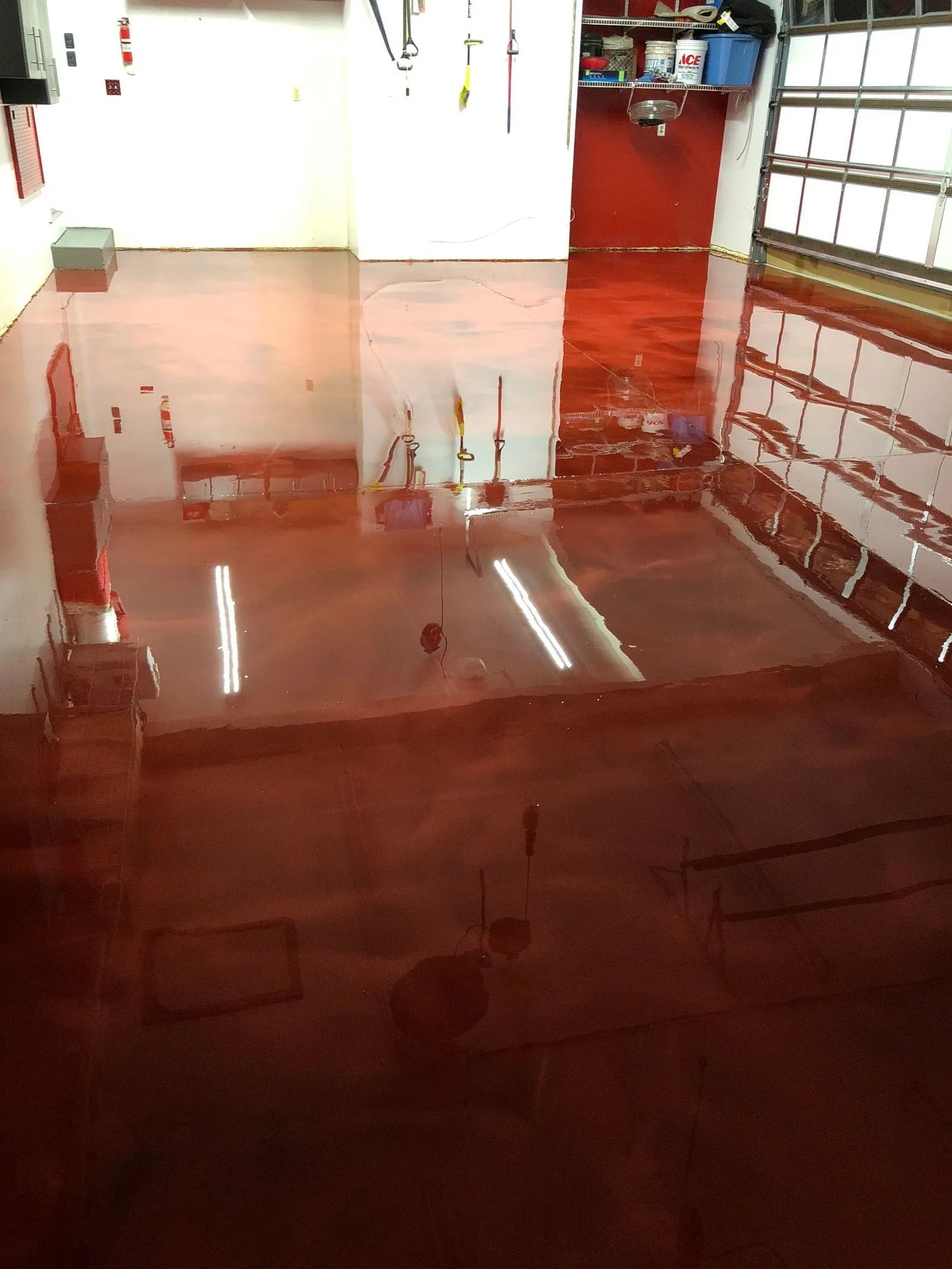
Can you coat a garage floor in winter in Utah?
Yes, if the slab clears the product’s minimum temperature and stays there through the cure. Most epoxies need the slab at 50 to 55 degrees. Polyaspartic systems are rated down to 35. In an unheated Wasatch Front garage in January the slab rarely gets there on its own, so winter coating means heat, a cold rated product, or waiting for March.
We coat garage floors in Centerville and along the Wasatch Front through the winter when the numbers work. The rest of this post is about when they do, using manufacturer data sheets and NOAA climate records rather than the claims on installer websites.
What temperature does a garage floor coating need?
The data sheets are specific, and they measure the slab and the material, not just the air.
| Product | Minimum temperature | Notes from the data sheet |
|---|---|---|
| Sherwin-Williams ArmorSeal 8100 water based epoxy | 50 degrees, air, surface and material | At least 5 degrees above the dew point; humidity 85 percent max |
| Sherwin-Williams ArmorSeal 650 self leveling epoxy | 55 degrees | Same dew point and humidity rules |
| Sika Sikafloor-264 epoxy | 50 degrees on the slab, 85 max | Pot life 25 minutes at 68 degrees, 50 minutes at 50; full cure 7 days at 68, 10 days at 50 |
| Rust-Oleum EpoxyShield store kit | 60 degrees air, 55 degree floor | Do not apply if temperatures will drop below 65 in the next 24 to 48 hours |
| Simiron Polyaspartic HS | 35 degrees, air and surface; material 60 to 85 | Below 60 degrees you must use the fast cure version |
| Aspartic 85 low temp polyaspartic | 30 degrees | Cold significantly slows recoat and return to service |
| Penntek XR 80 polyurea base coat | 55 degree floor, 75 for the slow set version | Marketed as a cold weather cure, but the floor minimum is 55 |
| Penntek UR 4800 top coat | 65 degree floor | 30 minute pot life |
Two things stand out. Epoxy has a hard floor at 50 degrees, and the store kit is stricter than the professional products. And the minus 20 or minus 40 numbers that show up on contractor sites are not on any data sheet we could find. The lowest published minimums are 30 and 35 degrees, and the big polyurea brand most garages are sold on wants 55 to 65 on the floor. If an installer quotes a subzero number, ask for the data sheet.
Why the slab matters more than the air
Sika’s sheet carries a line that explains most winter failures: the substrate temperature may be lower than the ambient temperature. Concrete is coupled to the ground, it holds cold for days, and it lags the air by a wide margin. Penntek tells installers to verify floor temperature, not room temperature. Heating a garage to 60 degrees does not put the slab at 60 degrees the same afternoon.
An infrared thermometer on the concrete is the real go or no go number. That, plus the dew point spread, decides whether the job happens.
What cold does to epoxy
Cold does not politely slow epoxy. Chemco Systems, an epoxy manufacturer, puts it this way: pot life and cure time roughly double for every 18 degree drop. A 25 minute gel time at 73 degrees is about 100 minutes at 37. Most ambient cure epoxies stop curing somewhere between 35 and 40 degrees. Below that you do not get a slow floor, you get a soft one that never hardens and has to be ground off.
Inside the approved window the penalty is still real. Sika’s own numbers for its Sikafloor-264 show full cure stretching from 7 days at 68 degrees to 10 days at 50, and the minimum recoat wait going from 8 hours to 24. The dew point is the other trap. Cold air holds less moisture, so the dew point sits close to the air temperature, and a cold slab can drop below it. Condensation you cannot see mixes into the curing epoxy and pulls amines to the surface, which leaves a greasy film called amine blush. It hazes the gloss, stays tacky, and blocks the next coat from bonding.
Which Utah months actually work?
NOAA’s 1991 to 2020 normals put Salt Lake City’s average high at 51 degrees in November, 39 in December, 39 in January, 45 in February and 55 in March. Ogden runs 2 to 3 degrees colder, and Davis County sits between the two. Those are air temperatures at the airport, not slab temperatures in a garage, but they frame the season.
We also ran the last decade of NOAA daily records for Salt Lake City to see how often the air clears the epoxy threshold.
| Month | Days reaching 50 degrees | Days reaching 55 degrees |
|---|---|---|
| November | 55 percent | 39 percent |
| December | 18 percent | 9 percent |
| January | 11 percent | 3 percent |
| February | 37 percent | 21 percent |
| March | 70 percent | 52 percent |
Read that as a ten year sample, not a normal. It says November is barely winter for this work. December and January are the real problem: about one January day in nine reaches 50 in Salt Lake City, one in seventeen in Ogden, and waiting for a warm spell in January is waiting for a 3 percent event. The window reopens in late February and is wide open in March. An attached garage runs warmer than the airport, and the slab in either kind runs colder, so use these as a screen and the thermometer as the decision.
Inversions: the worst week to coat
Salt Lake sits in a bowl. In December, January and February a layer of warm air caps the cold air on the valley floor, snow cover reflects the sun instead of absorbing it, and the cold pool sits until a storm scours it out. The benches can run 20 to 30 degrees warmer than the valley during an inversion, so a regional forecast can badly misjudge a Bountiful or Salt Lake garage.
Inversions also push humidity up and the dew point toward the air temperature. That is the exact condition that causes condensation on a cold slab and amine blush in an epoxy. A cold slab and high humidity at the same time make an inversion week the worst week of the year to coat a floor in the valley.
How installers coat in winter
A heated attached garage held above 60 degrees is a normal indoor job. Epoxy or polyaspartic both work. The crew still checks the slab temperature, the dew point spread and the moisture reading, and nothing else changes.
An unheated attached garage is the common case. The house is warm, but the slab is tied to the ground and the door opens every day, so it sits below 50 through December and January. The fix is supplemental heat held through the cure, 24 to 72 hours, with the door shut the whole time. The heat has to be clean. Unvented open flame heaters, the propane torpedo and salamander type, put moisture and carbon dioxide into the air, and Euclid Chemical and Chemco both warn that combustion exhaust degrades a curing epoxy. Electric or indirect fired heat only.
A detached unheated garage is the hardest case. It takes a curing tent and clean heat, or a low temperature polyaspartic rated to 30 or 35 degrees, and even then the slab has to clear the number. In every case the door stays shut through the job and the cure, which is a scheduling detail people do not expect.
When you should wait
Wait when the slab is below the product minimum, no matter what the air says. Wait when the slab is within 5 degrees of the dew point or humidity is above 85 percent. Wait if the concrete is frozen, damp, or over the moisture limit, and if it is less than 28 days old. Wait if the forecast drops below the product’s hold temperature in the 24 to 48 hours after application.
Salt is the Utah specific reason to wait or prep hard. Brine off the car soaks into the pores, and chlorides left in the concrete block the bond. The fix is a neutralized and rinsed etch or a mechanical grind, and specifically not a pressure wash, which drives the salt deeper. A slab that has taken a winter or two uncoated needs more prep than a new one. A slab that is actively salt loaded in February is a warranty claim waiting to happen if it is coated over. And a floor that is cracked and spalled needs repair before any coating, in any season.
The upside of a winter install
Done right, a winter coating means next winter’s salt never reaches the concrete. Indoor floors, garages, basements and shops, are less weather dependent than patios and decks, so winter is when that work gets scheduled. Some installers say lead times run shorter in winter than in the spring rush. We cannot prove that with industry data, but the temperature table above shows why demand piles into March and April.
The honest version is this. A heated garage can be coated any month. An unheated one can be coated in winter with heat and the right product, and the slab reading decides it. A cold rated polyaspartic top over an epoxy base is the usual winter build, and the trade offs between those two are in epoxy versus polyaspartic garage floors. Once the floor is down, what it costs and how long it lasts are covered in what an epoxy garage floor costs in Utah and how long a garage floor coating lasts here.
If you want a floor before spring, call (801) 347-4518 Monday through Friday, 8am to 5pm. We come out, put a thermometer on the slab, and tell you whether it can be coated this month or should wait for March. The estimate is free either way.