
How long does a garage floor coating last in Utah?
A professionally installed garage floor coating lasts 10 to 20 years in a Utah garage, and an epoxy base with a polyaspartic top coat is rated 15 to 20 years or more by the manufacturers who warranty it. Store bought kits last 1 to 3 years. The spread comes down to solids content, prep, and what the floor takes each winter.
Those ranges are from published cost guides, manufacturer data sheets and warranty documents, not from our own floors. We install garage floor coatings along the Wasatch Front and pass on the manufacturer’s warranty for whatever system goes down.
How long does each system last?
Solids content is most of the story. Professional systems run 90 to 100 percent solids. Most big box kits run 40 to 50 percent solids, thinned with water and fillers, and go down at about 3 mils. Concrete Network puts epoxy at 15 to 20 years only when it is 100 percent solids and installed correctly. This Old House puts water based epoxy at 1 to 3 years under real traffic.
| System | Typical life | What usually ends it |
|---|---|---|
| Store kit, water based, 40 to 50 percent solids | 1 to 3 years | Hot tire pickup and peeling; thin film over an acid etch |
| Professional 100 percent solids epoxy, no separate top coat | 10 to 20 years; 5 to 10 in many guides | Ambering and chalking from sun, wear in the tire lanes |
| Epoxy base with a polyaspartic or urethane top coat | 15 to 20 years or more | Top coat wear in the drive lane, which can be recoated |
| Full polyaspartic or polyurea | 10 to 20 years; Penntek backs its system with a 15 year residential warranty | Moisture vapor blistering on a wet slab |
| Bare concrete with a sealer | Acrylic 1 to 3 years, penetrating 3 to 7, epoxy or urethane sealer 5 to 10 | Sealer wears off, then salt scaling and spalling start |
The last row matters in Utah. A sealer is cheaper than a coating, and we do plenty of concrete sealing on driveways and patios, but a garage floor in a road salt region wants a fresh coat as often as every year or two. A coated floor is the longer lasting answer inside the garage.
Why do garage floor coatings fail?
Hot tire pickup is a heat and adhesion problem, not wear. Tires come home well above 100 degrees on a summer afternoon. A thin water based coating softens under that heat, the rubber grips it as it cools, and the coating leaves with the car. It shows up weeks or months after the install, not the day of. Polyaspartic top coats cure harder and hold up better, though Sherwin-Williams still recommends mats under the tires on its own polyaspartic sheet.
Peeling and delamination are almost always prep failures. Concrete Network says a high percentage of coating failures come down to surface prep and contamination. The three usual causes are moisture vapor coming up through the slab, oil that was never fully removed, and acid etching used in place of diamond grinding. Etch leaves residue and an uneven profile. Grinding opens a consistent profile the coating can lock into.
Moisture vapor deserves its own line. Concrete breathes, and soil moisture moves up through the slab. Trapped under a coating, it pushes the film off in blisters. Polyaspartic is less tolerant of this than epoxy, which is one reason the base coat is usually epoxy. A moisture test before coating, by calcium chloride or an in slab humidity probe, is how installers catch it.
Sun is a chemistry problem. Epoxy is aromatic and ambers under UV. Polyaspartic is aliphatic and does not, which is why it goes on top. Grit is the everyday problem: sand and de-icer tracked in on tires is the abrasive that dulls the drive lane over years.
What Utah does to a garage floor
Road salt is the big one. UDOT pre-treats with salt brine, spreads white salt and high performance salts through the storms, and, according to Deseret News and KSL reporting, uses magnesium chloride and beet juice blends as well. KSL puts the state’s salt use at roughly 500,000 cubic yards a year. All of it rides home in the wheel wells and drips onto the slab as the car warms.
Chloride brine does not sit on top of concrete. It soaks into the pores, and when the temperature drops that moisture freezes and expands about 9 percent, fracturing the surface. That is spalling. The chlorides also react with the lime in cured concrete to form calcium oxychloride, an expansive crystal that breaks the slab down from the inside. Salt Lake City sees about 26 days a year that never climb above freezing, and dozens of freeze and thaw swings around them. A coating is the barrier that keeps the brine on top, where it rinses off.
Sun and altitude add to it. Salt Lake City sits at about 4,300 feet, and UV increases a few percent for every thousand feet of elevation. A south facing garage with the door open gets more UV than the same garage at sea level, which is the argument for an aliphatic top coat over bare epoxy. Utah’s dry air and big daily temperature swings stress the bond and the joints too. One Utah installer sums the local load up as freeze thaw cycles, magnesium chloride and intense sun, and that is a fair list.
How prep changes the lifespan
Diamond grinding creates the surface profile that lets a coating mechanically lock into the slab. Acid etching leaves an inconsistent profile and a residue that blocks adhesion, and it puts water into the concrete that has to dry out before anything goes on. Poor profiling is the number one reason coatings peel, and no product choice fixes it. A polyaspartic over an etched floor fails like an epoxy over an etched floor.
Moisture testing is the second gate. ASTM F710 says the slab should be under 3 pounds of moisture vapor per 1,000 square feet per day, or under 75 percent internal humidity, before it takes a coating unless the manufacturer says otherwise. A cheap test up front prevents the blisters that show up a year later.
Crack repair is the third. Warranties exclude damage that comes from cracks in the substrate, so a crack that is not routed and filled before coating becomes the owner’s problem when it telegraphs through. That is why every one of our floors starts with crack, spall and pit repair before color, and why a failed store kit gets ground to bare concrete instead of coated over.
Maintenance that adds years
Sweep or dust mop the floor often, because grit is what dulls the tire lanes. Wipe up oil, antifreeze and brake fluid when you see them. Mop with a pH neutral cleaner and rinse. Skip ammonia and vinegar, since both break down the top coat. In winter, rinse the salt off the floor after a snowy week instead of letting the brine sit. Keep mats under the tires for the first few weeks while the coating reaches full cure, and any time a car comes in hot.
Re-topcoating is the one thing that resets an aging floor. Sources disagree on the calendar, anywhere from 2 to 3 years to 7 to 10, so go by condition. When the gloss dulls in the drive lane, a new clear coat over the existing floor restores it without redoing the base.
What a warranty actually covers
Read the exclusions. One large national installer’s lifetime warranty covers peeling and delamination for as long as the original owner has the house, covers staining from oil and fluids for 10 years only if the spill is wiped within 20 minutes, and covers labor for one year. It excludes UV fading, water damage, cracks in the slab, and any floor whose moisture vapor exceeds 8 pounds. It does not transfer to the next owner. Other warranties define lifetime as five years, or exclude vehicle traffic outright, which is the whole point of a garage floor.
Our approach is simpler to state. We pass on the manufacturer’s warranty and apply every product to the manufacturer’s specifications. The terms depend on the system, and we go over them at the estimate.
What to expect at 5 and 10 years
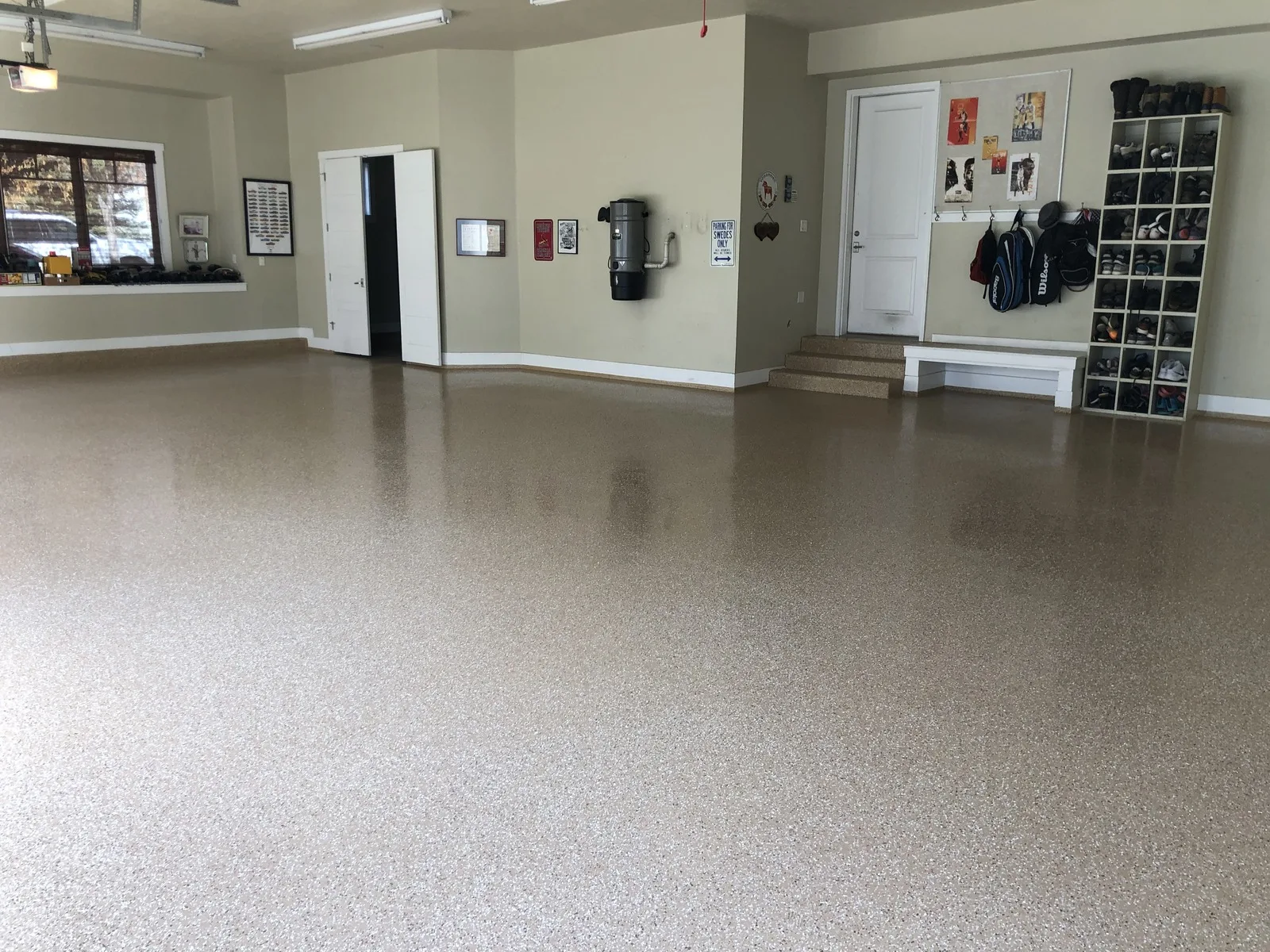
At five years a properly ground, top coated flake floor shows dulling where the tires roll and not much else. No peeling, no bubbles, no edge lift, and tire marks still wipe off. By ten years the gloss is visibly down in the drive lane and the top coat is thinning there. That is when a fresh clear coat pays for itself. A floor that peels at two years was a prep problem or a kit, and the fix is grinding and starting over.
How the two chemistries share the work is covered in epoxy versus polyaspartic garage floors, and the price of doing it right is in what an epoxy garage floor costs in Utah. If your floor is at the peeling stage, call (801) 347-4518 Monday through Friday, 8am to 5pm. We come out, look at the slab, and tell you whether it needs a top coat or a fresh start. The estimate is free.